
Continuous Improvement in Action: How VIP Apps Consulting Helps Clients Get the Most from Their Systems
Every organisation invests significant time, money, and effort into its business systems. But once implementation is complete, how do you ensure those systems continue delivering value year after year?
At VIP Apps Consulting, that’s the question that drives our methodology. As Tom Spencer, a Senior Consultant at VIP Apps, explains, the company’s approach is designed not only to implement technology effectively, but also to ensure that clients continue to realise the full potential of their investment over time.
In this insight, Tom shares how VIP Apps’ platform-first philosophy and its proprietary AMOBI methodology work together to support continuous improvement, efficiency, and measurable business impact.
Getting the Foundation Right: A Practical and Sustainable Implementation Approach
For VIP Apps, every successful project begins with understanding the business in detail.
“The first step on every project is a full requirements activity,” Tom explains. “We work with the business and all key users to pull out every requirement they have for the new system.”
These requirements are then mapped against standard business processes—a crucial step that ensures alignment between how a company operates and how the software is designed to function. The outcome is a set of standard process flows that highlight what the system supports, where the gaps are, and what needs to be addressed.
This baseline analysis becomes the cornerstone of implementation. But rather than jumping straight into development, the team takes a disciplined, platform-aligned approach.
“Our methodology is to work with the standard application,” Tom says. “We don’t make changes to the base code. This reduces maintenance costs and makes upgrades far easier in the future.”
By respecting the structure of the core application, VIP Apps helps clients maintain flexibility and protect their long-term investment, avoiding the technical debt that often comes from over-customisation.
Smart Add-ons, Not Customisations
When productivity gaps emerge, VIP Apps’ consultants focus on non-intrusive enhancements—what Tom calls “add-ons.” These are designed to deliver meaningful efficiency gains without altering the system’s foundation.
“We build non-intrusive solutions using standard APIs,” Tom explains. “They’re about solving real-world productivity challenges.”
These add-ons typically automate repetitive or time-consuming tasks, such as:
- Mass uploads of contracts or assets directly from spreadsheets or other systems
- Data integrations between separate platforms, eliminating the need for manual input
- Bulk updates, like changing customer details across multiple records simultaneously
Each enhancement is designed to improve user experience, reduce manual workload, and streamline operations—all while keeping the system clean, stable, and ready for future upgrades.
“It’s not about changing the system,” Tom emphasises, “but about helping people work more efficiently with it.”
The Platform Advantage Philosophy
This mindset is part of what the VIP Apps team calls their Platform Advantage philosophy—a belief that value comes not from how much code is written, but from how intelligently technology is applied.
Every business system, whether it’s a core leasing platform, ERP, or CRM, already includes powerful features and modules designed to handle most business needs. The key is to understand, optimise, and fully leverage those capabilities before turning to custom development.
Tom summarises it simply:
“The platform is there for a reason. The vendor has invested heavily in developing it. Our job is to help clients make the most of it.”
From Implementation to Continuous Improvement: The AMOBI Methodology
VIP Apps Consulting’s proprietary AMOBI methodology takes this philosophy a step further. Developed over a decade ago by Tom, Daypesh Patel, and Matt Bawden, AMOBI provides a structured framework for ongoing optimisation and continuous improvement.
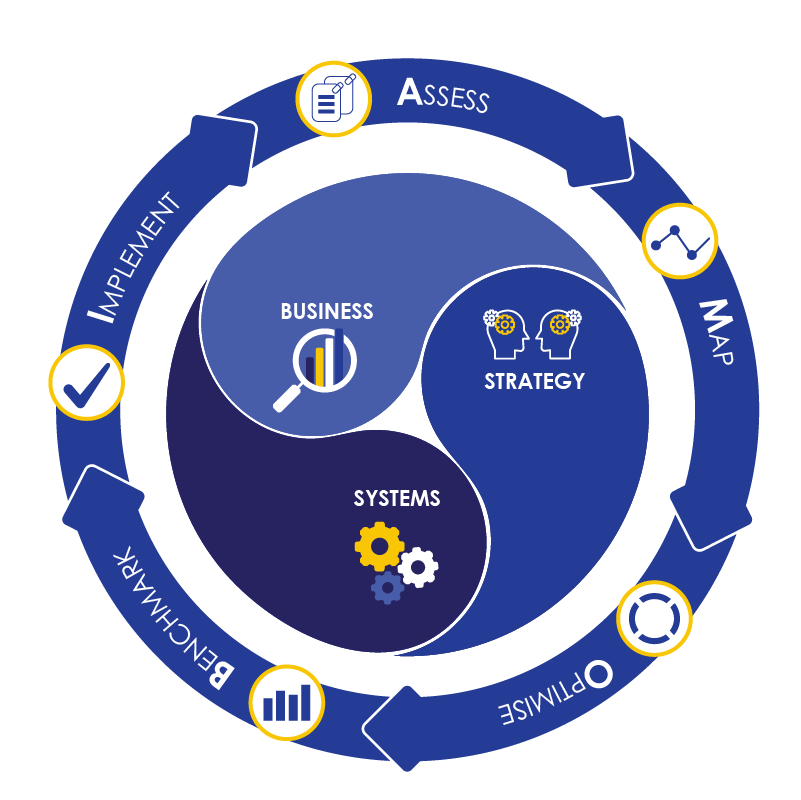
AMOBI stands for:
- Assess: Identify business pain points and opportunities for improvement.
- Map: Align issues with current processes and system functionality.
- Optimise: Define and design solutions to enhance performance and user experience.
- Benchmark: Measure and record results, establishing clear performance indicators.
- Implement: Deliver and monitor the improvements, ensuring they become part of the continuous improvement cycle.
As Tom explains:
“AMOBI isn’t a one-off activity. It’s a continuous cycle. We revisit each business area regularly—typically every six months—to assess what’s working, what’s not, and where we can make further gains.”
This ongoing rhythm ensures clients continue to derive measurable benefits long after the initial implementation is complete.
The AMOBI Approach: A Holistic View of People, Process, and Technology
At its core, AMOBI takes a holistic approach—balancing the needs of people, business processes, and technology.
It helps organisations ask the right questions:
- Are our people and processes aligned with our IT solutions?
- Are we using all the capabilities we’ve licensed?
- Where are inefficiencies or off-system workarounds costing us time and money?
By focusing on real business events and workflows, the Assess phase targets the high-impact pain points that restrict system value—whether due to inefficient processes, underutilised modules, or inconsistent user adoption.
The Map and Optimise phases use event-based flow mapping and benchmarking to streamline manual or inefficient steps. The goal is not just to make processes faster, but to ensure that technology, process, and people operate in harmony, supporting business objectives and enhancing user engagement.
Built on Industry Standards, Designed for Measurable Results
One of AMOBI’s greatest strengths is that it’s built on proven frameworks such as TOGAF, ArchiMate, and Lean Six Sigma. This ensures that improvements are:
- Structured and repeatable across the organisation,
- Focused on areas that deliver the highest value, and
- Measurable against clear success criteria.
As the framework drives change, it provides benchmarking tools to quantify results and demonstrate ROI. Clients can track improvements in KPIs like turnaround times, system utilisation, and process efficiency—making AMOBI not just a methodology, but a governance tool for ongoing excellence.
The Real Value: Continuous Improvement and Measurable Business Impact
The combination of VIP Apps’ implementation discipline and the AMOBI methodology delivers a powerful outcome:
Clients gain a solution that not only works on day one, but keeps improving as their business evolves.
“By following this continuous cycle,” Tom says, “we help our clients keep getting better. They get more value from their system every time we assess, optimise, and baseline.”
This continuous improvement mindset also strengthens relationships between VIP Apps consultants and their clients. Projects evolve into partnerships—where consultants act as strategic allies, helping business and technology teams align around shared goals.
Unlocking the Full Value of Your Technology Investment
In today’s fast-changing financial and leasing landscape, standing still means falling behind. Systems that were once cutting-edge can quickly become bottlenecks if not continuously reviewed and optimised.
That’s where AMOBI makes the difference. It transforms implementation into an ongoing journey of improvement, helping organisations maintain alignment between business goals, user experience, and system performance.
At VIP Apps Consulting, we believe that success isn’t just about implementing the right technology—it’s about continuously unlocking its full potential.
Interested in learning how AMOBI can help you optimise your business systems and processes? Discover more about our methodology.