
How System Integration Streamlines Finance Workflows in Financial Services
Finance teams often deal with multiple systems, manual handoffs, and constant pressure to improve efficiency. These challenges can create bottlenecks and prevent finance teams from working at their full potential. If you’ve noticed delays, inconsistent data, or too many spreadsheet workarounds, you’re not alone. System integration helps change that. When your tools and data work together seamlessly, your team gains a clear view of every process. Decisions become quicker, information flows smoothly, and everyone spends less time on manual work and more time adding real value.
Let’s explore how system integration can improve finance workflows, reduce manual tasks, and transform your organisation’s operations without the need for expensive system overhauls.
Why Do Finance Workflows Become Slow and Manual in Financial Services?
In many financial services organisations, the typical finance workflow looks like this: multiple disconnected systems, manual handoffs between teams, and time spent chasing data that should already be available. This creates bottlenecks, especially at month-end or during reporting periods. The problems aren’t necessarily with the systems themselves, but rather how they interact, or in many cases, how they don’t.
Some common issues include:
- Disconnected systems: Without proper integration, data is often entered manually across different platforms, leading to duplication of effort.
- Workarounds: Spreadsheets or offline processes emerge to bridge system gaps, which increase the risk of errors.
- Outdated processes: Legacy systems, while still functional, might be ill-suited to the demands of modern finance operations.
These problems often stem from how systems and processes work together. If your organisation’s systems are siloed and lack integration, workflows will inevitably become inefficient. Integration connects your systems, ensuring smooth data exchange and faster decision-making, without requiring a complete overhaul of existing tools.
What Does System Integration Mean in a Finance Context?
System integration in finance refers to the process of connecting various software applications and platforms to work together seamlessly. In a typical finance operation, you may have an ERP system, an accounting tool, CRM software, and other specialised platforms all working in isolation. When these systems don’t communicate with each other, it results in slow and error-prone processes.
The goal of system integration is to allow data to flow freely between your systems, ensuring that all financial data is consistent and up to date. For instance, instead of manually transferring data from one system to another, an integrated system allows information to be automatically updated and reflected across all platforms. This reduces the risk of errors, enhances reporting capabilities, and improves the overall speed of your finance operations.
Business Process Management (BPM) plays a key role in system integration by ensuring that all your processes are streamlined and optimised before integration, helping you avoid bottlenecks and inefficiencies.
What Common Finance Problems Can System Integration Help Fix?
Finance professionals often encounter a range of inefficiencies that hinder productivity. These can include delays, errors, and the constant need to switch between systems or spreadsheets. Here’s how system integration can help resolve these issues:
- Month-end close delays: When your systems are connected, data flows automatically between them, reducing the time it takes to complete reconciliations and generate reports.
- Inconsistent data: With integration, all platforms share real-time, accurate data, eliminating inconsistencies and errors across your records.
- Manual reconciliations: Automated data transfers between systems significantly reduce the need for manual reconciliations, improving accuracy, and saving time.
- Limited visibility: When systems aren’t integrated, you can’t see the full picture. Integration provides a real-time view of your finance processes, so you can spot bottlenecks and address them quickly.
By connecting your systems, you’re setting the stage for more efficient, accurate, and transparent finance operations.
Why Is It Important to Understand Finance Processes Before Integrating Systems?
It can be tempting to implement system integration without thoroughly assessing your existing finance processes, but this is often a mistake. System integration is most effective when it’s preceded by a deep understanding of how your workflows currently operate.
Here’s why this is crucial:
- Optimisation first: If you don’t optimise your finance processes before integrating, you might end up automating inefficiencies. Understanding your current workflows ensures that integration is used to enhance, not just automate, processes.
- Identifying the right areas for improvement: Not all processes benefit equally from integration. By assessing your current workflows, you can identify where integration will have the biggest impact.
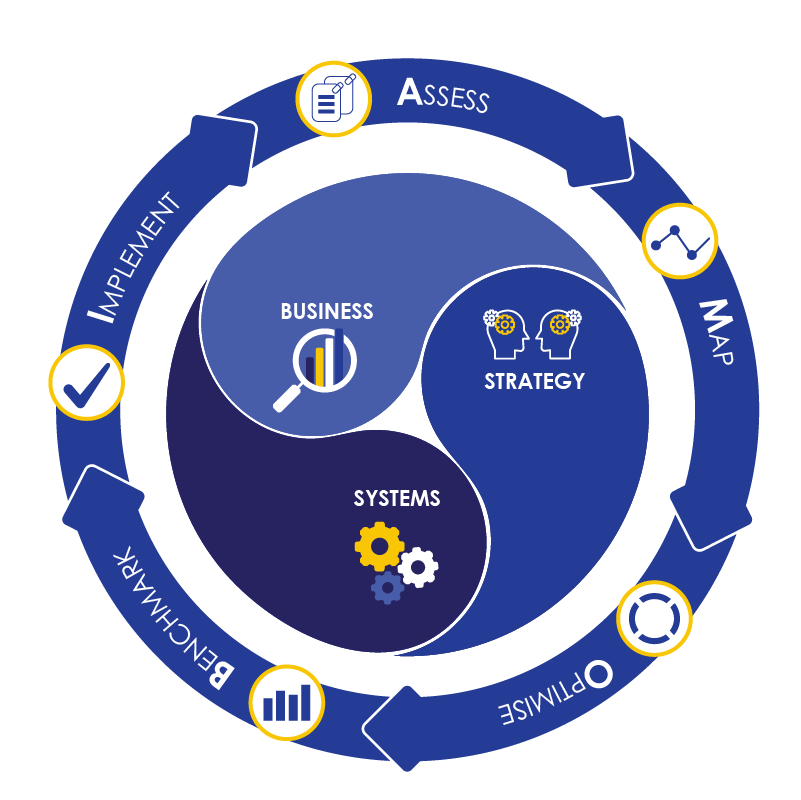
- AMOBI methodology: Our AMOBI methodology (Assess, Map, Optimise, Benchmark, Implement) ensures we thoroughly evaluate your processes before integrating systems. By understanding where the pain points lie, we can optimise processes first, benchmark improvements against real operational outcomes, then design the right system integration strategy that aligns with your goals.
How Can Financial Services Firms Identify the Best Areas for System Integration?
Before integrating systems, it’s essential to assess your current finance processes and prioritise which areas would benefit most. A structured system assessment can help identify the gaps and opportunities for improvement, ensuring that system integration addresses the right challenges.
Our AMOBI methodology takes a holistic, process-first approach to evaluating your systems and processes. We look at:
- People: How do your teams interact with the current systems?
- Processes: What are the steps involved in your finance workflows?
- Technology: Which systems are in place, and where are the gaps?
This structured assessment ensures that integration efforts are focused on areas with the highest potential for improvement, resulting in a smoother and more effective implementation.
How Have Financial Services Organisations Improved Finance Workflows Using AMOBI Framework System Integration?
VIP Apps Consulting has helped numerous financial services organisations improve their workflows through the AMOBI methodology integration. Here are a few case studies demonstrating how our approach has delivered results:
- Volvo Financial Services North America: When Volvo needed to replace a 20-year-old credit system, our team applied AMOBI to ensure a smooth transition with minimal disruption. The integration was completed without affecting the existing finance workflows, enabling the company to improve its processes and reduce operational costs.
- European Captive Leasing Start-Up: Aiming to deploy three new business entities in Europe, we helped optimise processes and implement Oracle Lease and Finance Management (OLFM). Our approach allowed the client to meet tight deadlines and budget constraints while maintaining the integrity of their financial systems.
- Huntington Technology Finance: By standardising their lease management platform, Huntington reduced system support costs and shifted resources to customer-facing technology, increasing overall operational efficiency.
These case studies highlight how applying a structured, process-first approach to system integration leads to more predictable and successful outcomes.
How Can an AMOBI Assessment Identify the Right Integration Opportunities?
If your finance team is struggling with inefficient workflows, the first step is to optimise your processes. Once your processes are streamlined, system integration can improve efficiency and eliminate bottlenecks without the need for costly system overhauls.
Through the AMOBI methodology, we can help you identify where system integration will have the greatest impact. This approach ensures that your technology supports your finance team’s needs, allowing you to improve operations while making the most of your current systems.
Let’s work together to enhance your finance workflows. Contact us today to begin your AMOBI assessment and discover how we can help you integrate systems for smoother, more efficient operations.