

The Rise of the Headless Enterprise
A big transformation is under way in how enterprise software is built, deployed, and consumed. For two decades, the graphical user interface was the front door to every business system. Every workflow was designed around a human sitting in front of a screen, clicking through records, filling in fields, and manually moving work from one stage to the next. The platform existed to serve the person using it.
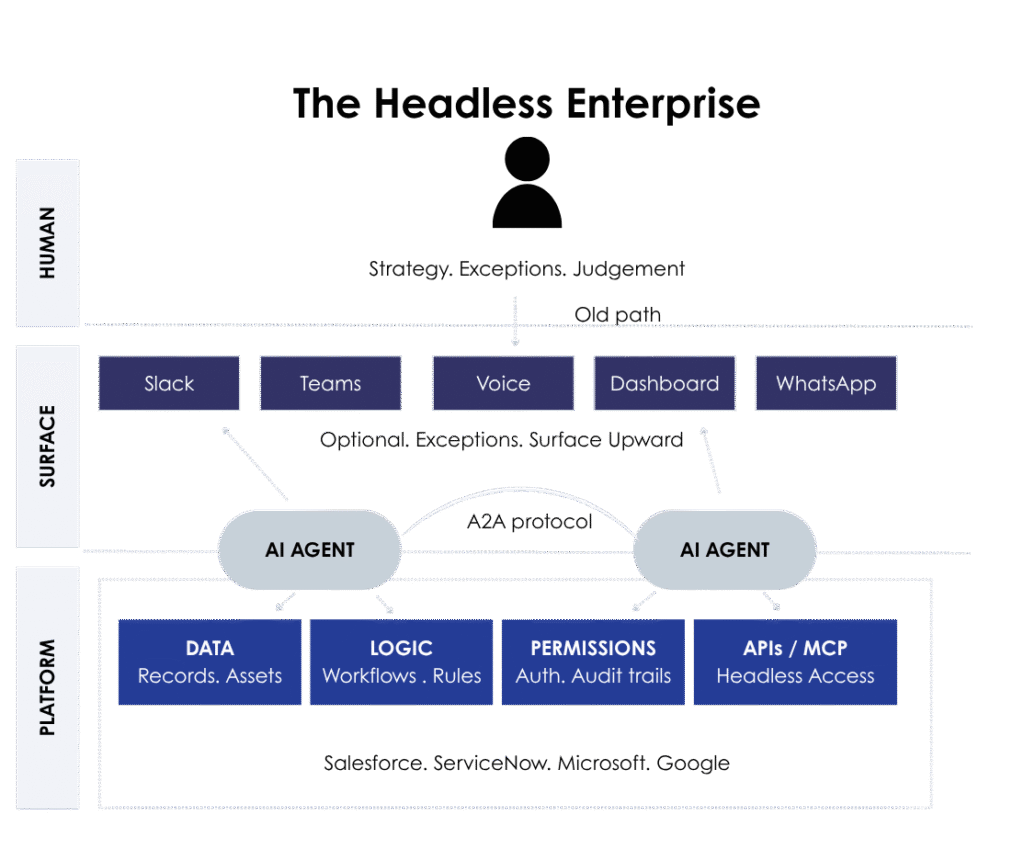
That relationship is now inverting. AI agents operate at the execution layer, below the interface, directly within the platform’s logic, data, and permissions. They do not browse; they act. Click by click, screen by screen, the old way of working is becoming optional. Which is precisely why “the API as the user interface” has moved from developer hacks to a board-level architectural principle, and why every major enterprise platform is now restructuring itself around it.
Salesforce, with its recent launch of Headless 360, has made every capability on its platform accessible as an API, a Model Context Protocol (MCP) tool, or a command-line interface. Microsoft is embedding its business workflows directly into Copilot, Teams, and the Power Platform, enabling AI agents to execute governed processes without opening a traditional application. Google, at Cloud Next 2026, launched the Gemini Enterprise Agent Platform with managed MCP servers and an Agent-to-Agent (A2A) protocol now in production at more than 150 organisations. ServiceNow, at Knowledge 2026, introduced Action Fabric, an architectural layer that exposes its entire system of workflows and business processes headlessly to any AI agent, whether built on ServiceNow or a third-party platform.
The scale of this shift is significant. Gartner predicts that by the end of 2026, roughly 40% of enterprise applications will have embedded task-specific AI agents, up from under 5% in 2025. IDC forecasts tens of billions of agentic API calls per day by 2027. In the most forward-thinking organisations, the platform has become the authoritative source of record, the agent has become the primary actor within it, and the human has moved upstream, setting strategy, reviewing exceptions, and making the judgement calls that automation cannot.
For asset finance, equipment finance, leasing, and lending, the implications are immediate and tangible. In asset finance, the deal no longer waits for someone to open a dashboard. Where transactions are driven by the value and condition of the underlying asset, agents can monitor collateral data, trigger valuations, and manage covenants autonomously, removing days from a process that has historically been measured in weeks. In equipment finance, where volume and margin pressure demand operational efficiency, headless automation means application intake, credit scoring, and documentation can run as parallel background processes rather than sequential manual tasks. For lessors, where the relationship between funder, broker, and lessee involves multiple handoffs and compliance touchpoints, AI agents operating natively within the platform can orchestrate those interactions without any human party needing to log in and chase. In lending, where covenant monitoring, drawdown management, and portfolio review have traditionally consumed significant analyst time, the headless model enables continuous, automated oversight, surfacing exceptions and decisions wherever the work is happening, whether in Slack, Microsoft Teams, WhatsApp, or voice interfaces.
Putting Headless Architecture to Work
Knowing that headless architecture is the direction of travel is one thing. Having the methodology to implement it safely, at pace, and with measurable commercial outcomes is another entirely. VIP Apps Consulting has spent over a decade building exactly that capability and is now deploying it at scale across the sector.
Using its AMOBI methodology, the firm deploys AI agents directly within Salesforce for its commercial lending and leasing clients across asset finance, equipment finance, leasing, and lending. Application intake, document verification, and credit decisioning workflows operate as efficient background processes, ensuring underwriters, brokers, and relationship managers remain focused on high-value decisions rather than navigating multiple screens. For brokers managing high volumes of equipment finance proposals, this means faster decisioning and fewer dropped applications. For lessors running complex multi-party transactions, it means compliance and documentation workflows that complete themselves.
For commercial lenders, it means a portfolio that manages itself while the team manages the strategy.
“For years, the industry centred on how to make enterprise software easier for people to use. That conversation has fundamentally shifted. Our clients today are not asking how their teams navigate the platform. They are asking whether their data and processes are robust enough to let an agent operate within them autonomously. That readiness is now the competitive edge, and building it is where the real transformation work happens.” Daypesh Patel, Managing Director, VIP Apps Consulting Limited
“Deep domain expertise is what makes platform capabilities truly effective. Our alliance with VIP Apps Consulting is critical for customers in Asset Finance and Leasing, and using AMOBI to drive process optimisation is a genuine game changer for digital transformation in Originations.” Charlie Sutton, Head of Alliances, UK Financial Services, Salesforce
Process Integrity is the Foundation for Headless AI
The industry’s move toward headless, agent-driven execution is generating significant debate among practitioners. Most organisations are not yet close to ready for fully invisible workflows. A considerable gap exists between theoretical potential and operational readiness, and governance, monitoring, identity management, and clear process ownership are prerequisites, not afterthoughts. Underlying platform configuration remains as critical as ever; what has changed is that it now serves as the launchpad for agentic execution rather than the end goal in itself.
This is particularly true in regulated sectors such as asset finance, equipment finance, and commercial lending, where audit trails, credit policy compliance, and FCA obligations mean that every automated action must be traceable, governed, and defensible. VIP Apps Consulting maintains that technology achieves its full potential only when built upon a high-performing, well-governed workflow. Through its AMOBI methodology, the firm ensures that every process is assessed, mapped, and benchmarked before any technical deployment begins, so that AI agents deliver measurable commercial value from day one and scale with the confidence of a process that has been proven to perform.
The headless, agentic enterprise is already operating inside the most ambitious firms in asset finance, equipment finance, leasing, and lending. VIP Apps Consulting is the partner that knows exactly what to build, and what to leave behind.