
Dreamforce 2026: Is This the End of FS Interfaces as We Know Them?
Following three days at the Moscone Center in San Francisco, the message from Dreamforce 2026 is clear: the transition to agentic AI in financial services has begun. From AIforce and Agentforce to Claudeforce and Koa, Salesforce’s latest announcements point to a future where banks, wealth managers and lenders interact with their data through autonomous agents and conversational interfaces rather than traditional dashboards.
Sun, Scale and Flawless Execution
Returning from the Moscone Center, we are witnessing a structural change away from the traditional interfaces that have defined how banks, wealth managers, and lenders interact with enterprise software. For decades, financial services have relied on interfaces that dictate human action. From the green screens of historical terminals to the complex web dashboards of today, these systems have always required constant human input and manual decision making. The shift to agentic systems suggests an end to these traditional FS interfaces, moving us toward a future where AI handles the operation autonomously. Dreamforce was a packed 3 days full of visionary keynotes, impressive AI product launches, and valuable time spent meeting customers, clients, and partners.
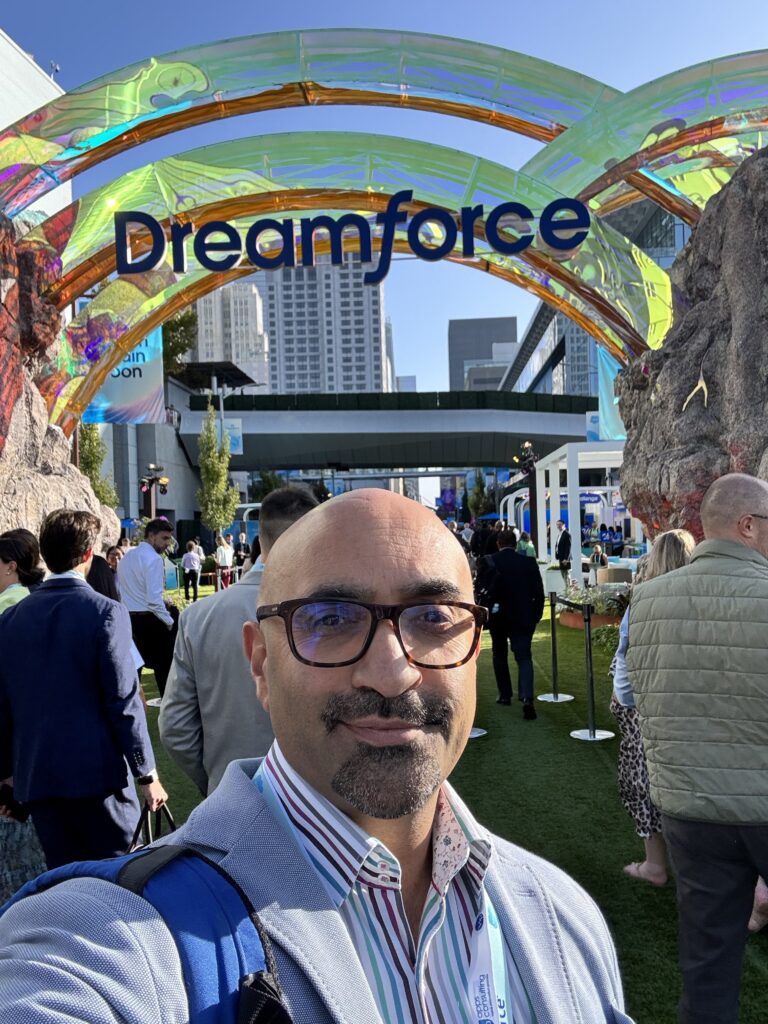
The Dreamforce events team executed the massive scale perfectly. Managing a crowd of this size requires serious logistical planning, and their crowd controls were flawless. Attendees were provided with deliciously balanced lunches and snacks. With a DJ always playing nearby, the good vibes continued seamlessly between strategic sessions.
The AI Safety Debate
Dreamforce serves as a primary showcase for Salesforce product updates, and this year it also functioned as a live public forum on the future of AI. Marc Benioff assembled a prominent group of executives, sharing the stage with NVIDIA CEO Jensen Huang and Anthropic CEO Dario Amodei, followed by a fireside chat with OpenAI CEO Sam Altman.
The defining moment of the event was a direct debate on AI pacing and safety. This discussion carries significant implications for risk-averse financial institutions.
As I shared while at the event, Jensen Huang set the tone early with a clear directive. He told the audience, “Don’t get left behind,” arguing that we must advance AI capabilities and safety concurrently.
Dario Amodei focused on how the combination of the leading CRM and leading AI is transforming business. He highlighted the importance of customer data, autonomous agents, the choice of AI models, and the shift to a conversational interface. He also warned that the industry needs to slow down, verify, and build tighter parameters to prevent severe risks. This perspective aligns deeply with modern risk and compliance frameworks.
During their fireside chat, Sam Altman and Marc Benioff discussed openly the risks, pitfalls, and the year-on-year impact of AI on people and the enterprise. Altman took a middle position on pacing. He supported regulatory frameworks and safety accountability without endorsing a full halt on frontier model development.
Major Platform Announcements
The primary theme of the product keynotes was a fundamental change in interaction. Salesforce will now operate wherever your advisors, loan officers, and agents already work. Conversational and agentic AI is becoming the new interface, replacing the need to click through traditional dashboards and menus.
- AIforce is the Live Interface Layer and the most significant announcement of the week. It is an architecture that makes Salesforce data, metadata, logic, and permissions available to supported AI experiences. For a wealth advisor, this means bypassing the GUI entirely to query a client portfolio, risk tolerance, and recent interactions directly from a secure chat interface.
- Agentforce introduces a suite of pre-built autonomous agents ready to execute tasks immediately. In a FinServ context, Agentforce allows specialized bots to autonomously handle routine KYC checks, qualify initial loan inquiries, or resolve tier-1 retail banking service tickets.
- Claudeforce highlights a deepening partnership with Anthropic by integrating Claude advanced reasoning directly with Salesforce data. This brings complex analytical capabilities to workflows, such as synthesizing corporate earnings reports or drafting highly personalized, compliant client communications.
- Koa is a brand new CRM-specific reasoning model built with NVIDIA on Nemotron 3 Super. For financial data, where hallucination is unacceptable, a model specifically trained on structured business logic provides a critical safety control.
- Headless 360 is the foundational architecture that makes AIforce possible. It exposes every Salesforce cloud as a reusable enterprise capability via open standards. This capability is vital for integrating legacy banking mainframes with modern AI layers.
The Impact on Commercial Lending
For asset finance, lending, and leasing businesses, the announcements at Dreamforce 2026 signal the end of manual, delayed origination workflows. The introduction of Agentic AI means that the labour-intensive tasks of the lease lifecycle can now be managed by autonomous agents working alongside human underwriters to achieve unprecedented revenue growth. These autonomous tasks include initial credit checks, collateral valuation modelling, generating term sheets, and managing end-of-term renewals.
Having previously spent a decade managing front-office investment banking systems and now leading digital strategy in asset finance, I can confidently state that the technology to orchestrate these complex, multi-step financial processes is officially ready.
The next phase relies entirely on digital strategy. We have an incredible opportunity to advance commercial lending and achieve unprecedented efficiency. To utilise these new agentic capabilities safely and effectively, firms must comprehensively evaluate their current operations and optimise processes.