
UK AI Adoption 2026: Why Businesses Are Missing AI’s Growth Opportunity
UK businesses are investing heavily in artificial intelligence, and adoption is climbing faster than ever. But new research shows most organisations are still using AI narrowly, as a cost-cutting tool, rather than as a driver of growth, innovation and better decision-making. At VIP Apps Consulting, we believe this narrow focus is the single biggest reason UK businesses aren’t yet seeing AI show up in revenue.
As UK businesses accelerate investment in AI and automation, attention has centred almost entirely on improving efficiency, reducing manual work and cutting operational costs. We believe organisations now need to look beyond short-term savings and build an AI strategy that creates new opportunities and improves long-term business performance.
UK AI Adoption Statistics 2026: The Efficiency Trap
Recent figures show just how quickly AI adoption in the UK is moving. According to the Office for National Statistics (ONS), 29% of UK businesses reported using at least one form of AI technology by June 2026 — up eight percentage points on the previous year — with adoption reaching 49% among businesses with 250 or more employees.
Yet growth in AI adoption hasn’t translated into growth in revenue for most firms. Independent research compiling UK survey data shows that while around three-quarters of AI-using businesses report productivity gains, only around one in eight report an increase in revenue as a result. In other words, UK businesses are getting faster and leaner with AI — but relatively few are yet using it to open up new value.
This is the gap VIP Apps Consulting sees again and again with clients: AI is being deployed to do the same things more cheaply, rather than to do new things better.
“AI Should Not Simply Be Viewed as a Cost-Cutting Tool”
“AI should not simply be viewed as a cost-cutting tool,” says Daypesh Patel, Managing Director of VIP Apps Consulting Limited. “The real opportunity is using technology to help businesses make better decisions, improve customer experiences and create new ways of working that support long-term growth.”
VIP Apps Consulting, which provides AI and digital transformation consulting to organisations across financial services, leasing and technology, sees many businesses approaching AI adoption from a technology-first perspective rather than starting with the business challenge they are trying to solve. Tools get selected before problems are properly defined — and the result is often a series of disconnected AI pilots that shave time off individual tasks without shifting the organisation’s overall performance.
Building an AI Strategy That Starts With the Problem, Not the Platform
Successful AI adoption depends on understanding existing processes, identifying where meaningful improvements can be made, and ensuring AI solutions deliver practical benefits for teams and customers — not just headline efficiency metrics.
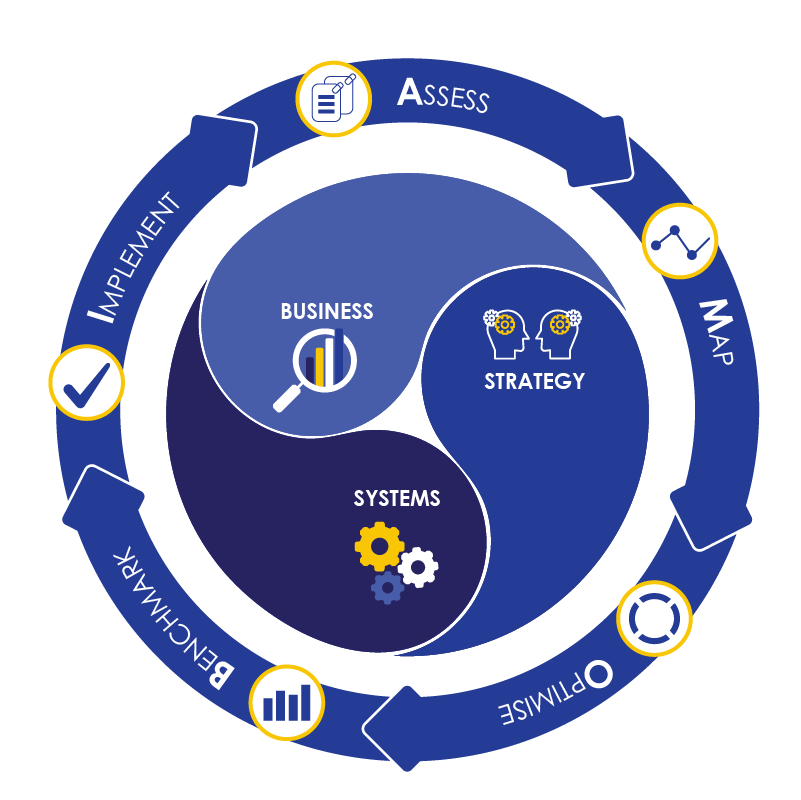
That’s the thinking behind VIP Apps Consulting’s AMOBI methodology — our structured framework for AI strategy consulting:
- Assess – review current processes, data and technology maturity
- Map – identify where AI can create measurable business value
- Optimise – refine processes before layering on technology
- Benchmark – set clear, measurable success criteria
- Implement – deploy AI solutions tied directly to business outcomes
Applied consistently, the AMOBI methodology helps clients move past isolated automation projects and towards AI initiatives tied directly to growth objectives — whether that’s faster, better-informed decision-making, stronger customer retention or the ability to launch new services more quickly.
AI for Financial Services: Beyond Automation
For financial services and leasing firms in particular, the potential of AI extends well beyond automation. Organisations can use AI to improve customer journeys, strengthen decision-making, streamline operations and build more agile business models — capabilities that matter just as much for growth as for cost control.
“Technology is only valuable when it solves a real business problem,” adds Patel. “The organisations that succeed with AI will be those that focus less on the technology itself and more on what they want to achieve.”
What’s Next for AI Adoption in UK Businesses
VIP Apps Consulting believes the next phase of AI adoption in the UK will be defined by businesses that move beyond cost optimisation and start using AI as a genuine driver of growth. As adoption continues to climb across the UK, the organisations that pull ahead won’t necessarily be the ones using the most AI — they’ll be the ones using it with the clearest sense of what they’re trying to achieve.
Frequently Asked Questions
According to the Office for National Statistics, 29% of UK businesses reported using at least one AI technology by June 2026, rising to 49% among businesses with 250 or more employees.
Research shows most UK businesses currently deploy AI to improve efficiency and cut costs rather than to support growth. Around three-quarters of AI-using businesses report productivity gains, but only around one in eight report increased revenue, suggesting AI strategy is skewed toward cost-cutting rather than value creation.
AMOBI is VIP Apps Consulting’s proprietary AI adoption framework: Assess, Map, Optimise, Benchmark and Implement. It helps organisations identify genuine business opportunities for AI and implement solutions tied to measurable outcomes, rather than adopting technology for its own sake.
Beyond automating manual tasks, financial services and leasing firms can use AI to improve customer journeys, strengthen decision-making, streamline operations and build more agile, responsive business models.
How can financial services firms use AI beyond automation?
Beyond automating manual tasks, financial services and leasing firms can use AI to improve customer journeys, strengthen decision-making, streamline operations and build more agile, responsive business models.
Sources: Office for National Statistics, Business Insights and Conditions Survey (June 2026); compiled UK AI adoption research, 2026.